
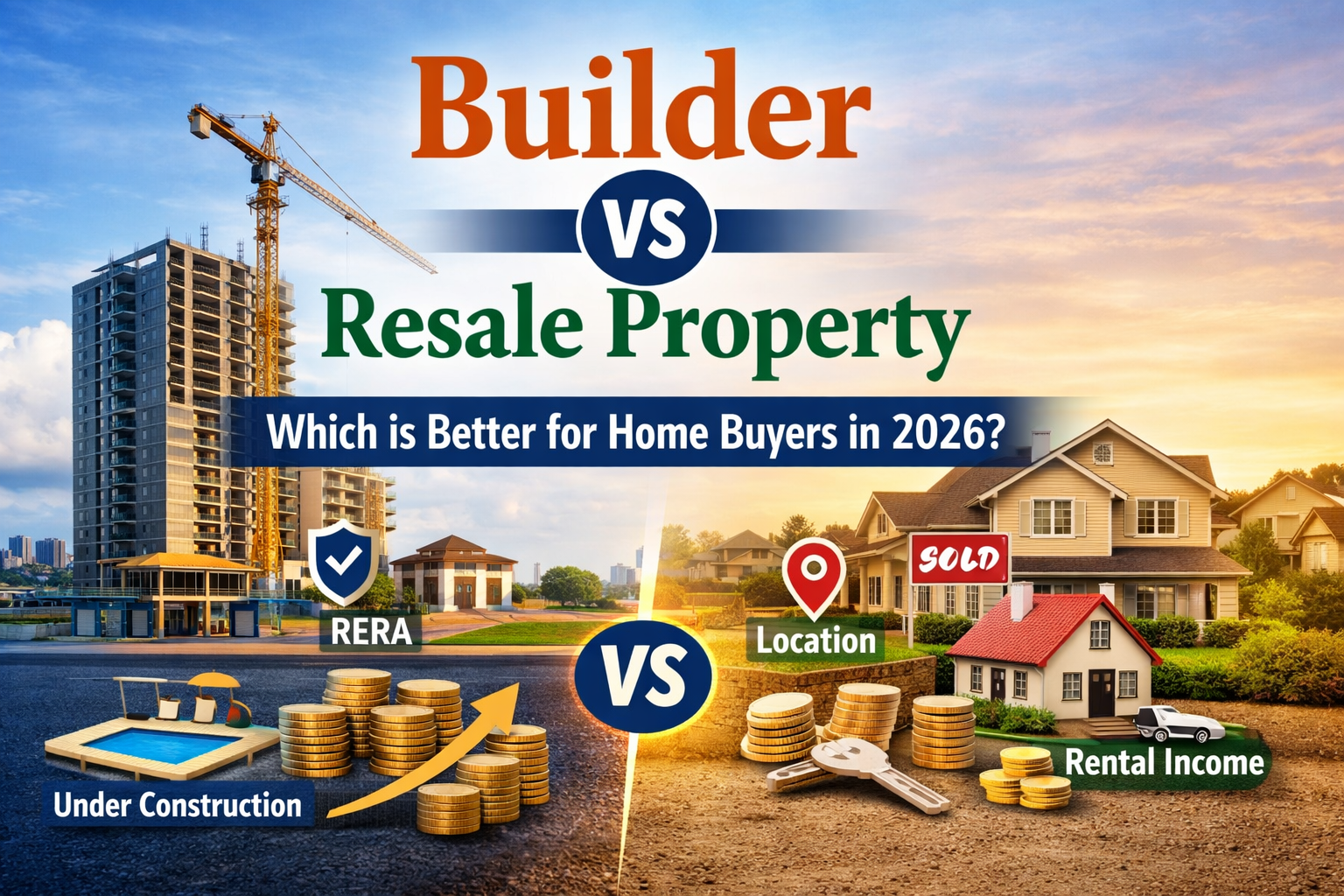
Choosing between a builder property and a resale property is one of the most common dilemmas faced by homebuyers today. Both options come with their own set of benefits, costs, and risks, making the decision more complex than it seems. Whether you are buying for self-use or investment, understanding the difference between the two is crucial before making a final decision.
Why Buyers Are Confused Between Builder and Resale Properties
Buying a home is one of the biggest financial decisions in a person’s life. However, many buyers often find themselves confused when choosing between a builder property and a resale property. Both options have their own advantages, risks, and financial implications. While builder properties offer modern amenities and flexible payment plans, resale properties provide immediate possession and established neighborhoods. This difference in benefits makes it difficult for buyers to decide which option truly suits their needs.
Another major reason for confusion is pricing. Builder projects may include additional charges like GST, PLC (Preferential Location Charges), and maintenance deposits, whereas resale properties may involve negotiation opportunities but also require careful legal verification. Investment goals, budget, possession timeline, and lifestyle preferences further complicate the decision-making process.
Overview of Both Options
A builder property is purchased directly from a developer, either in an under-construction project or a ready-to-move development. These properties typically offer new construction, modern designs, better amenities, and structured payment plans.
On the other hand, a resale property is bought from an existing owner. It is usually located in a well-developed area with established infrastructure, and buyers can often take immediate possession after completing the transaction.
Both options serve different purposes depending on the buyer’s financial plan, urgency, and long-term goals.
Who Should Read This Guide
This guide is ideal for:
- First-time homebuyers
- Real estate investors
- Buyers comparing ready-to-move vs under-construction options
- Anyone planning to purchase property in growing markets like Noida, Gurgaon, or other emerging cities
By the end of this article, you will have a clear understanding of which property type aligns best with your needs and investment objectives.
Also Read: M3M & Smartworld Tie Up With ELIE SAAB for ₹3,500 Cr Luxury Homes in NCR
What is a Builder Property?
A builder property refers to a residential or commercial property that is purchased directly from a real estate developer. These properties are usually part of newly developed projects and can be either under construction or ready for possession. Builder properties are popular among buyers who prefer modern designs, better amenities, and structured payment plans.
Unlike resale properties, builder units are brand new and often come with updated layouts, contemporary architecture, and lifestyle facilities such as clubhouses, landscaped gardens, smart security systems, and parking spaces.
Under-Construction vs Ready-to-Move Projects
Under-Construction Projects are properties that are still being built. Buyers invest during the development phase and typically benefit from lower launch prices and flexible payment plans. However, possession may take time, and there is always a risk of project delays.
Ready-to-Move Projects, on the other hand, are fully completed properties where buyers can take immediate possession. There is no waiting period, and buyers can physically inspect the property before purchase. Additionally, GST is not applicable on ready-to-move properties (as per current tax rules), making them financially attractive for many buyers.
Buying Directly from the Developer
When purchasing a builder property, buyers deal directly with the developer or the developer’s authorized sales team. This often ensures transparent pricing structures, official documentation, and easier access to payment plans such as construction-linked or possession-linked plans.
Developers may also offer early-bird discounts, festive offers, subvention schemes, or flexible payment options to attract buyers during project launches.
New Launch Projects Explained
A new launch project is a property that has just been introduced to the market by a developer. These projects are usually offered at pre-launch or launch prices, which are lower compared to later stages of construction.
Investing in a new launch can provide higher appreciation potential if the project is located in a developing area. However, buyers must carefully verify the developer’s reputation, RERA registration, and project approvals before investing.
Overall, builder properties are ideal for buyers seeking modern amenities, long-term appreciation, and newly constructed homes.
Also Read: Top Reasons to Invest in Pre-Launch Real Estate Projects
What is a Resale Property?
A resale property is a property that is being sold by its current owner rather than the original developer. In simple terms, it is a pre-owned property that has already been purchased once and is now being resold in the market. Resale properties can include apartments, independent houses, villas, or even plots located in established residential areas.
Many buyers prefer resale properties because they are usually situated in well-developed neighborhoods with ready infrastructure such as schools, hospitals, markets, and public transport.
Definition of Resale Property
A resale property refers to any real estate unit that has had at least one previous owner. Unlike builder properties, these units are not sold directly by the developer. The transaction typically involves negotiations between the buyer and the current owner, often facilitated by a real estate agent.
Resale properties are generally ready-to-move, meaning buyers can take possession shortly after completing the legal and financial formalities.
Buying from an Individual Owner
When purchasing a resale property, buyers deal directly with the existing owner. The pricing is often negotiable, which can be an advantage compared to fixed builder rates. However, buyers must conduct thorough legal due diligence, including:
-
Verifying clear property title
-
Checking previous ownership records
-
Ensuring no outstanding loans or dues
-
Confirming society transfer procedures
Home loan approval may also involve additional documentation, as banks carefully evaluate the property’s legal history.
Old vs Newly Resold Properties
Resale properties can be categorized into older properties and newly resold properties:
-
Older Properties are typically 8–15 years old or more. They may require renovation or upgrades but are often located in prime, well-established areas.
-
Newly Resold Properties are recently purchased units that are being sold again, sometimes even before possession. These properties are relatively modern and may offer better layouts and amenities compared to older homes.
Choosing between old and newly resold properties depends on budget, maintenance costs, and location preference.
Overall, resale properties are ideal for buyers who want immediate possession, established surroundings, and negotiation flexibility.
Also Read: BOOTES Enters Residential Real Estate: A ₹6,300 Crore Strategic Expansion
Price Comparison: Builder vs Resale Property
Price is one of the most important factors when choosing between a builder property and a resale property. While the base price may appear similar at first glance, the overall cost structure can vary significantly. Buyers must look beyond the quoted price and carefully evaluate additional charges, negotiation opportunities, and long-term expenses before making a decision.
Initial Purchase Cost
In most cases, under-construction builder properties are launched at attractive pre-launch or early-bird prices. Developers often offer flexible payment plans, which reduce the immediate financial burden. However, the final cost may increase as the project progresses.
On the other hand, resale properties are usually priced based on current market value and location demand. Since they are ready-to-move, buyers pay the full agreed amount at the time of purchase (either through savings or a home loan). There is no waiting period, which can save rental expenses if the buyer needs immediate possession.
Negotiation Scope
One major advantage of resale properties is the scope for negotiation. Individual owners may be willing to negotiate based on urgency, market conditions, or property condition. This flexibility can sometimes help buyers secure a better deal.
In contrast, builder property prices are often more structured and less negotiable, especially in high-demand projects. However, developers may offer indirect benefits such as:
- Waiver of floor rise charges
- Free parking
- Stamp duty discounts
- Flexible payment schemes
Hidden Charges (GST, PLC, Maintenance, Transfer Fee, etc.)
Hidden or additional charges can significantly impact the final property cost.
In builder properties, buyers may need to pay:
- GST (applicable on under-construction projects)
- PLC (Preferential Location Charges)
- Floor rise charges
- Club membership fees
- Maintenance deposit
- Parking charges
In resale properties, while GST is not applicable, buyers may encounter:
- Transfer fees charged by the society
- Brokerage fees
- Pending maintenance dues
- Minor renovation or repair costs
Therefore, understanding the complete cost breakdown is essential before finalizing any property. A clear comparison of total expenses — not just the base price — helps buyers make a financially sound decision.
Also Read: Top 15 Real Estate Projects in Delhi NCR for Investment in 2026
Payment Plans & Home Loan Differences
When comparing builder and resale properties, understanding the payment structure and home loan process is essential. The way payments are scheduled and how banks approve loans can significantly impact your cash flow and overall financial planning.
Construction-Linked Plans
A Construction-Linked Plan (CLP) is commonly offered in under-construction builder projects. Under this plan, the buyer pays in stages based on the progress of construction.
For example:
- 10% at booking
- 10% on completion of foundation
- 10% on completion of structure
- Remaining amount in further construction milestones
This plan reduces the immediate financial burden and aligns payments with project progress. However, buyers must be prepared for potential construction delays, which may affect possession timelines.
Possession-Linked Plans
A Possession-Linked Plan (PLP) requires buyers to pay a smaller amount upfront, with the majority of the payment due at the time of possession.
This option is beneficial for buyers who want to minimize EMI payments during construction. However, the final lump sum amount at possession can be substantial, so proper financial planning is necessary.
Resale properties generally do not offer structured payment plans. The buyer usually pays the agreed amount in one go (via savings and/or home loan) at the time of registration and transfer.
Loan Approval Process Comparison
For builder properties, banks often have pre-approved projects. This can simplify the home loan process because the bank has already verified the project’s legal and technical details. Loan disbursement in under-construction projects is usually done in stages, matching the construction-linked plan.
For resale properties, the loan process may require more detailed scrutiny. Banks will verify:
- Clear property title
- Ownership history
- Encumbrance certificate
- Society NOC (if applicable)
Loan disbursement for resale properties is typically made in a single installment directly to the seller after documentation is complete.
In summary, builder properties offer structured and flexible payment options, while resale properties provide straightforward transactions but require full payment readiness at the time of purchase.
Also Read: Top 50 Real Estate Builders in Delhi NCR By Growmore Realtors
Possession & Waiting Time
Possession timeline plays a crucial role in deciding between a builder property and a resale property. Some buyers need immediate occupancy, while others are willing to wait for future appreciation. Understanding the waiting period and potential risks helps in making a practical decision.
Immediate Possession in Resale
One of the biggest advantages of a resale property is immediate possession. Since the property is already constructed and occupied (or vacant), buyers can move in shortly after completing the legal formalities and registration process.
This is especially beneficial for:
- Families currently paying rent
- Buyers relocating for work
- Investors looking for immediate rental income
With resale properties, there is minimal uncertainty regarding completion because the unit physically exists and can be inspected before purchase.
Delay Risks in Under-Construction Projects
In contrast, under-construction builder projects come with a waiting period that can range from 1 to 4 years, depending on the stage of construction.
Although many developers commit to fixed timelines, delays may occur due to:
- Regulatory approvals
- Labor shortages
- Supply chain issues
- Financial constraints of the developer
Even with RERA regulations in place to protect buyers, delays can still impact financial planning, especially if the buyer is paying both rent and EMIs simultaneously.
Timeline Comparison
- Resale Property: Immediate or short possession period (usually within 1–3 months after paperwork).
- Under-Construction Builder Property: Possession based on project completion timeline (may take several years).
- Ready-to-Move Builder Property: Immediate possession, similar to resale, but generally at a higher price than under-construction units.
In summary, resale properties are ideal for buyers seeking quick occupancy and certainty, while under-construction builder properties may suit those who are willing to wait for potentially better pricing and long-term appreciation.
Also Read: Godrej Arden Greater Noida – A Lush Green Luxury Address in Sigma III
Amenities & Modern Infrastructure
Amenities and infrastructure are major deciding factors for today’s homebuyers. Modern residential projects focus not just on providing living space but on delivering a complete lifestyle experience. This is where builder properties and resale properties often differ significantly.
Clubhouse, Gym, Security & Smart Features
Most new builder projects are designed as gated communities with premium lifestyle amenities such as:
- Clubhouse and community halls
- Fully equipped gymnasium
- Swimming pool
- Children’s play area
- Landscaped gardens
- 24/7 security with CCTV surveillance
- Smart access control systems
- Dedicated parking spaces
Many new developments also offer smart home features like video door phones, app-based visitor management, and energy-efficient systems.
In contrast, resale properties, especially older ones, may not offer modern facilities. While some established societies do have basic amenities like security and parking, they may lack advanced lifestyle features that are now considered standard in new projects.
Lifestyle Benefits in New Projects
Builder properties are often part of planned townships that provide a well-designed living environment. Wide internal roads, green spaces, jogging tracks, retail zones, and community events enhance the overall lifestyle experience.
For families and young professionals, these amenities improve convenience, safety, and quality of life. Additionally, modern architecture and better space utilization make new homes more appealing and comfortable.
Limitations in Older Resale Properties
Older resale properties may have certain limitations such as:
- Outdated building design
- Limited parking availability
- Higher maintenance requirements
- Aging infrastructure (lifts, plumbing, wiring)
- Fewer recreational facilities
However, resale properties in prime, established locations may compensate for these limitations through better connectivity and developed surroundings.
In conclusion, if modern amenities and a premium lifestyle are priorities, builder properties may offer greater advantages. On the other hand, resale properties may appeal to buyers who value location and immediate usability over luxury features.
Also Read: Flat in Noida Expressway – A Prime Location to Buy Property
Legal & Documentation Process
The legal and documentation process is one of the most critical aspects of buying any property. Whether purchasing a builder property or a resale property, buyers must ensure that all legal formalities are properly verified to avoid future disputes or financial losses.
RERA Protection in New Projects
For builder properties, especially under-construction projects, RERA (Real Estate Regulatory Authority) plays an important role in protecting buyers.
Under RERA regulations:
- Projects must be registered with the authority.
- Developers must provide clear project details, approvals, and timelines.
- Funds collected from buyers must be used specifically for that project.
- Buyers are entitled to compensation in case of unjustified delays.
Before investing in a builder property, buyers should verify the RERA registration number and review project details on the official RERA website. This adds a layer of transparency and reduces the risk of fraud.
Title Verification in Resale Properties
In resale transactions, the responsibility of legal verification becomes even more important. Since the property has had previous ownership, buyers must carefully examine:
- Clear and marketable property title
- Chain of ownership documents
- Encumbrance certificate (to check outstanding loans or legal dues)
- Society NOC (if applicable)
- Property tax receipts and maintenance clearance
Banks also conduct legal checks before approving a home loan, but independent legal verification by a property lawyer is highly recommended to ensure complete safety.
Risk Factors in Both Options
Both builder and resale properties carry certain risks:
Builder Property Risks:
- Project delays
- Changes in layout or specifications
- Developer financial instability
Resale Property Risks:
- Title disputes
- Hidden legal liabilities
- Pending dues or unauthorized construction
Therefore, thorough documentation review and professional legal advice are essential regardless of the property type.
In summary, while RERA provides added protection in new projects, resale properties require deeper title verification. Proper due diligence is the key to a secure and hassle-free property purchase.
Also Read: Great Value Ekanam Sector 107 Noida: Premium 3 & 4 BHK Apartments
Appreciation & Investment Potential
For many buyers, property is not just a place to live but also a long-term investment. Understanding appreciation trends and return potential is essential when choosing between a builder property and a resale property.
Capital Appreciation in New Launches
New launch projects often offer strong capital appreciation potential, especially when located in developing or high-growth corridors. Since these properties are introduced at pre-launch or early-stage prices, buyers may benefit from price appreciation as:
- Construction progresses
- Infrastructure develops in the surrounding area
- Demand increases upon project completion
In many cases, property prices rise significantly between launch and possession. However, appreciation largely depends on location, developer reputation, and market conditions.
Rental Income Potential
When it comes to rental income, resale properties often have an advantage due to immediate possession. Investors can start earning rental returns soon after purchase.
Builder properties can also generate good rental income, especially if they are ready-to-move units in prime locations with modern amenities. In fact, newly constructed properties with premium facilities may attract higher rent compared to older resale units.
Rental yield depends on factors such as:
- Location and connectivity
- Demand in the area
- Amenities and property condition
- Proximity to offices, schools, and commercial hubs
Long-Term ROI Comparison
In terms of long-term return on investment (ROI):
- Builder Properties (Under-Construction/New Launch): May offer higher appreciation potential if purchased at the right stage and in a growing area. However, they involve waiting time and market risk.
- Resale Properties: Offer stability, predictable rental income, and lower uncertainty. Appreciation may be steady but generally slower compared to early-stage new launches.
Ultimately, the better investment depends on the buyer’s financial goals. Those seeking higher growth potential may prefer new launches, while investors looking for immediate rental income and lower risk may find resale properties more suitable.
Careful market research and location analysis remain the key to maximizing returns in either option.
Also Read: Top 15 Mistakes to Avoid While Buying a Flat in India
Maintenance & Society Condition
Maintenance and overall society condition are important factors that directly impact your living experience and long-term costs. While builder properties often offer modern infrastructure, resale properties may come with established community systems. Understanding the maintenance structure helps buyers make a practical decision.
Maintenance Charges in Builder Projects
In new builder projects, maintenance charges are usually structured and managed by the developer initially or by a facility management company. Buyers may need to pay:
- Advance maintenance charges (1–2 years upfront in some cases)
- Clubhouse maintenance fees
- Security and housekeeping charges
- Sinking fund contribution
New projects typically have higher maintenance costs because they offer premium amenities such as swimming pools, landscaped gardens, lifts, power backup, and 24/7 security.
However, since everything is new, repair costs are usually minimal in the early years.
Renovation Cost in Resale Properties
Resale properties, especially older ones, may require renovation or upgrades before moving in. Common expenses may include:
- Painting and interior refurbishment
- Plumbing or electrical repairs
- Kitchen and bathroom remodeling
- Lift or common area repairs (in older societies)
Although monthly maintenance charges in older societies may be lower compared to luxury builder projects, buyers should consider potential one-time renovation costs while calculating the total investment.
Society Management Differences
In builder projects, the developer initially manages the society until a Residents’ Welfare Association (RWA) is formed. Maintenance services are often professional and organized during the early years.
In resale properties located in established societies, the RWA is usually already active. While this provides community stability and experience, the quality of management may vary depending on the residents and available funds.
In conclusion, builder projects may offer modern infrastructure with higher maintenance fees, whereas resale properties may have lower recurring charges but possible renovation expenses. Evaluating both short-term and long-term costs is essential before making a final decision.
Also Read: High ROI Real Estate Strategies for First-Time Investors
Pros & Cons of Builder Property
Before investing in a builder property, it is important to evaluate both the advantages and potential drawbacks. While new projects offer modern living and structured payment options, they may also involve certain risks depending on the stage of construction and developer reliability.
Pros of Builder Property
1. Modern Amenities & Infrastructure
Builder projects usually offer premium facilities such as clubhouse, gym, landscaped gardens, power backup, and advanced security systems.
2. New Construction & Contemporary Design
Homes are built with modern layouts, better space utilization, and updated construction standards.
3. Flexible Payment Plans
Options like construction-linked and possession-linked plans reduce the initial financial burden.
4. Higher Appreciation Potential (in Early Stages)
Investing at pre-launch or early construction stages can result in strong capital appreciation by the time of possession.
5. RERA Protection & Transparency
Registered projects provide better legal transparency and buyer protection under RERA regulations.
6. Lower Initial Maintenance Issues
Since everything is newly constructed, repair and renovation costs are minimal in the initial years.
Cons of Builder Property
1. Possession Delays (Under-Construction Projects)
Project delays can impact financial planning and may result in paying both rent and EMIs.
2. Additional Charges
Costs such as GST, PLC, floor rise charges, club membership fees, and maintenance deposits can increase the total price significantly.
3. Limited Negotiation Scope
Unlike resale properties, builder prices are often less negotiable, especially in high-demand projects.
4. Market Risk
If the market slows down or infrastructure development is delayed, expected appreciation may not occur.
5. Dependency on Developer Reputation
The success and timely completion of the project depend largely on the developer’s financial strength and track record.
In summary, builder properties are ideal for buyers seeking modern lifestyle amenities and long-term growth potential, but careful evaluation of the developer and project stage is essential before investing.
Pros & Cons of Resale Property
Resale properties are often preferred by buyers who want immediate possession and established surroundings. However, like any real estate investment, they come with both advantages and limitations that must be carefully evaluated.
Pros of Resale Property
1. Immediate Possession
One of the biggest advantages is that buyers can move in quickly after completing the legal process. There is no construction waiting period.
2. Established Location & Infrastructure
Resale properties are usually located in developed areas with ready infrastructure such as schools, hospitals, markets, and public transport.
3. Better Negotiation Scope
Since the deal is directly with the owner, there is often room for price negotiation depending on urgency and market conditions.
4. No GST (in Most Cases)
GST is not applicable on completed resale properties, which can reduce the overall cost compared to under-construction builder units.
5. Immediate Rental Income
Investors can start earning rental returns soon after purchase, making resale properties attractive for income-focused buyers.
Cons of Resale Property
1. Renovation & Repair Costs
Older properties may require painting, plumbing, electrical work, or interior upgrades, increasing the overall investment.
2. Outdated Amenities
Many older societies may not offer modern facilities such as clubhouses, smart security systems, or lifestyle features.
3. Legal Verification Complexity
Buyers must carefully verify ownership history, title clarity, outstanding dues, and society approvals.
4. Limited Customization
Unlike new builder projects where buyers may get layout or finishing options, resale properties are usually sold “as-is.”
5. Slower Appreciation (in Some Cases)
While resale properties in prime areas appreciate steadily, they may not offer the same high growth potential as early-stage new launch projects in developing locations.
In conclusion, resale properties are ideal for buyers seeking immediate possession, negotiation flexibility, and established neighborhoods. However, proper legal due diligence and budgeting for possible renovation costs are essential before finalizing the deal.
Also Read: Is 2026 the Best Year to Invest in Real Estate in India?
Who Should Buy a Builder Property?
A builder property is not suitable for every buyer. It is best suited for individuals who are financially planned, patient, and looking for modern living or long-term investment growth. Below are the types of buyers who should consider purchasing a builder property:
1. Long-Term Investors
Buyers who are looking for capital appreciation over time can benefit from investing in under-construction or new launch projects. Purchasing at an early stage often provides lower entry prices and higher growth potential upon project completion.
2. Buyers Seeking Modern Lifestyle Amenities
If you prefer gated communities with facilities such as a clubhouse, gym, swimming pool, landscaped gardens, and smart security systems, builder projects are a better option. These properties are designed to offer a premium and comfortable lifestyle.
3. Buyers Who Can Wait for Possession
Under-construction properties require patience. If you are not in urgent need of immediate possession and can manage EMIs along with rent (if applicable), a builder property may be suitable for you.
4. First-Time Homebuyers Looking for Structured Payment Plans
Builder properties often provide flexible payment options such as construction-linked plans, subvention schemes, and festive offers. This can reduce the financial burden compared to making a full payment upfront.
5. Buyers Interested in Newly Constructed Homes
If you prefer brand-new construction with modern layouts, fresh interiors, and minimal repair work in the initial years, builder properties are ideal.
6. Buyers Comfortable with Developer-Based Transactions
If you prefer purchasing directly from a developer with RERA protection and structured documentation, builder properties offer a more organized buying process.
In summary, a builder property is ideal for buyers who value modern infrastructure, long-term appreciation, and flexible payment structures, and who are comfortable with waiting for project completion if investing in an under-construction unit.
Also Read: Why Yamuna Expressway Is the Next Property Investment Hotspot
Who Should Buy a Resale Property?
A resale property is ideal for buyers who prioritize immediate possession, established locations, and price negotiation flexibility. It suits individuals who prefer certainty over waiting and want to physically inspect the property before making a final decision.
Below are the types of buyers who should consider purchasing a resale property:
1. Buyers Who Need Immediate Possession
If you are currently paying rent or relocating for work, a resale property allows you to move in quickly after completing the legal formalities. There is no construction waiting period.
2. Investors Seeking Immediate Rental Income
Resale properties are suitable for investors who want to start earning rental income right away. Since the property is already completed, it can be rented out immediately.
3. Buyers Who Prefer Established Locations
If location is your top priority, resale properties in developed areas offer better infrastructure, connectivity, schools, hospitals, and commercial hubs nearby.
4. Budget-Conscious Buyers Looking for Negotiation
Unlike builder properties with fixed pricing, resale deals often allow room for negotiation. Buyers may secure better pricing depending on market conditions and the seller’s urgency.
5. Buyers Who Want to Inspect the Exact Unit
In resale transactions, you can see the exact property you are purchasing — including construction quality, sunlight, ventilation, and surroundings — before making payment.
6. Risk-Averse Buyers
If you want to avoid risks related to project delays or developer issues, resale properties provide more certainty since the construction is already complete.
In conclusion, a resale property is best suited for buyers who value immediate possession, established surroundings, and transactional clarity, while being prepared to handle proper legal verification and possible renovation costs.
Final Verdict: Which Property Type is Right for You?
Choosing between a builder property and a resale property ultimately depends on your financial situation, investment goals, and possession timeline. There is no one-size-fits-all answer — the right choice varies from buyer to buyer.
If you are looking for modern amenities, flexible payment plans, and higher long-term appreciation potential, a builder property may be the better option — especially if you are comfortable waiting for possession and investing in a growing location.
On the other hand, if you need immediate possession, established infrastructure, and rental income right away, a resale property could be more suitable. It offers greater price negotiation flexibility and allows you to physically inspect the exact unit before purchase.
Quick Decision Guide
- Choose Builder Property if you want new construction, lifestyle amenities, and long-term growth.
- Choose Resale Property if you want ready possession, location stability, and immediate returns.
Before making a final decision, always evaluate:
- Your budget and loan eligibility
- Urgency of possession
- Location growth potential
- Legal verification and documentation
- Total cost (including hidden charges or renovation expenses)
In conclusion, both builder and resale properties can be excellent investments when chosen wisely. Careful research, financial planning, and professional legal advice will help you select the property type that aligns best with your needs and long-term goals.
FAQs: Builder vs Resale Property
Here are some frequently asked questions that buyers often have when comparing builder and resale properties:
Q1. Which is cheaper: Builder property or resale property?
It depends on the location and project stage. Under-construction builder properties may offer lower launch prices, but additional charges like GST, PLC, and maintenance can increase the total cost. Resale properties may have higher base prices in prime areas but often allow room for negotiation.
Q2. Is GST applicable on resale properties?
No, GST is generally not applicable on completed resale properties. However, GST applies to under-construction builder properties as per current tax regulations.
Q3. Which option offers better investment returns?
New launch builder projects in developing areas may offer higher capital appreciation. Resale properties, on the other hand, can provide stable and immediate rental income. The better option depends on your investment strategy.
Q4. Is it safer to buy a resale property?
Resale properties reduce the risk of construction delays since the unit is already completed. However, buyers must carefully verify title documents, ownership history, and pending dues to avoid legal issues.
Q5. Do builder properties have more amenities?
Yes, most new builder projects offer modern amenities such as clubhouses, gyms, swimming pools, smart security systems, and landscaped open spaces. Older resale properties may have limited facilities.
Q6. Which property type is better for first-time homebuyers?
First-time buyers who prefer flexible payment plans and modern infrastructure may choose builder properties. Those who need immediate possession and want to avoid waiting may prefer resale properties.
Q7. How important is location in both options?
Location is crucial in both cases. A resale property in a prime area may outperform a new builder project in a weak location. Always prioritize connectivity, infrastructure, and future growth potential.
Q8. Can I get a home loan for both builder and resale properties?
Yes, banks provide home loans for both options. However, resale properties may require additional legal verification compared to pre-approved builder projects.
Leave a Reply